
The Fungal Renaissance
Harnessing the Power of Medicinal Mushrooms for Optimal Health
SUPERFOOD
Health Guru Hub
12/24/20255 min read
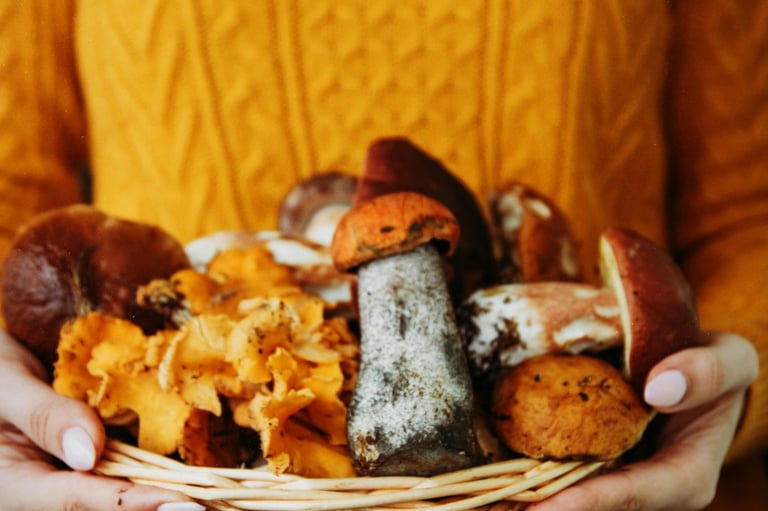

In the realm of natural health, medicinal mushrooms have emerged as a powerful and versatile ally, offering a wealth of benefits to support our well-being. These fungi possess remarkable adaptogenic, immunomodulatory, and antioxidant properties, making them invaluable in promoting overall health and combating various health challenges. This article explores the benefits of seven remarkable medicinal mushrooms: Lion's Mane, Reishi, Turkey Tail, Shiitake, Maitake, Chaga, and Cordyceps.
1. Lion's Mane (Hericium erinaceus)
- Neuroprotection and Neurogenesis: Lion's Mane is renowned for its neuroprotective and neurogenic properties. It stimulates the production of nerve growth factor (NGF) and brain-derived neurotrophic factor (BDNF), promoting neuronal growth and repair (1).
- Cognitive Function: Lion's Mane has been shown to improve cognitive function, memory, and concentration in clinical studies (2).
- Anti-inflammatory and Antioxidant Properties: Lion's Mane possesses potent anti-inflammatory and antioxidant properties, which help protect against oxidative stress and inflammation-related disorders (3).
2. Reishi (Ganoderma lucidum)
- Immune Modulation: Reishi is renowned for its immunomodulatory effects, enhancing both cellular and humoral immune responses. It has been shown to stimulate the production of natural killer (NK) cells, T-cells, and interleukin-2 (IL-2) (4).
- Antioxidant and Anti-inflammatory Properties: Reishi exhibits potent antioxidant and anti-inflammatory properties, protecting against oxidative stress and inflammation-related disorders (5).
- Hepatoprotection: Reishi has been shown to support liver function and protect against liver damage, making it an invaluable ally for individuals with liver-related health concerns (6).
3. Turkey Tail (Trametes versicolor)
- Immune Support: Turkey Tail is rich in polysaccharides, which have been shown to enhance immune function and support the body's natural defenses against infections and diseases (7).
- Antioxidant and Anti-inflammatory Properties: Turkey Tail possesses potent antioxidant and anti-inflammatory properties, protecting against oxidative stress and inflammation-related disorders (8).
- Detoxification: Turkey Tail supports the body's detoxification processes by promoting the production of urine and bile, which help eliminate toxins and waste products (9).
4. Shiitake (Lentinula edodes)
- Immune Modulation: Shiitake has been shown to modulate immune function, enhancing both cellular and humoral immune responses. It stimulates the production of interferon (IFN) and interleukin-1β (IL-1β), which help combat viral infections and cancer cells (10).
- Antioxidant and Anti-inflammatory Properties: Shiitake exhibits potent antioxidant and anti-inflammatory properties, protecting against oxidative stress and inflammation-related disorders (11).
- Cholesterol Lowering: Shiitake has been shown to lower LDL cholesterol and triglycerides, supporting cardiovascular health (12).
5. Maitake (Grifola frondosa)
- Immune Modulation: Maitake is known for its immunomodulatory effects, enhancing both cellular and humoral immune responses. It stimulates the production of interleukin-1β (IL-1β) and tumor necrosis factor-α (TNF-α), which help combat viral infections and cancer cells (13).
- Antioxidant and Anti-inflammatory Properties: Maitake possesses potent antioxidant and anti-inflammatory properties, protecting against oxidative stress and inflammation-related disorders (14).
- Antiviral and Anticancer Properties: Maitake has been shown to inhibit the replication of various viruses, including influenza and herpes simplex virus (HSV). It also exhibits anticancer properties, inhibiting the growth and proliferation of cancer cells (15).
6. Chaga (Inonotus obliquus)
- Immune Modulation: Chaga has been shown to modulate immune function, enhancing both cellular and humoral immune responses. It stimulates the production of interleukin-6 (IL-6) and interleukin-10 (IL-10), which help combat viral infections and cancer cells (16).
- Antioxidant and Anti-inflammatory Properties: Chaga exhibits potent antioxidant and anti-inflammatory properties, protecting against oxidative stress and inflammation-related disorders (17).
- Antiviral and Anticancer Properties: Chaga has been shown to inhibit the replication of various viruses, including influenza and HSV. It also exhibits anticancer properties, inhibiting the growth and proliferation of cancer cells (18).
7. Cordyceps (Cordyceps militaris)
- Energy and Stamina: Cordyceps is renowned for its ability to enhance energy, stamina, and athletic performance. It stimulates the production of adenosine triphosphate (ATP), the body's primary energy currency (19).
- Immune Modulation: Cordyceps has been shown to modulate immune function, enhancing both cellular and humoral immune responses. It stimulates the production of interleukin-2 (IL-2) and interferon-γ (IFN-γ), which help combat viral infections and cancer cells (20).
- Antioxidant and Anti-inflammatory Properties: Cordyceps exhibits potent antioxidant and anti-inflammatory properties, protecting against oxidative stress and inflammation-related disorders (21).
Action Steps for Incorporating Medicinal Mushrooms into Your Health Routine
1. Consult a healthcare practitioner: Before incorporating medicinal mushrooms into your health routine, consult with a qualified healthcare professional to ensure they are suitable for your individual needs.
2. Choose high-quality mushroom supplements: Opt for mushroom supplements that are third-party tested for purity, potency, and standardized extracts. Ensure the product is free from contaminants and heavy metals.
3. Start with lower doses: Begin with lower doses and gradually increase as tolerated. Typically, medicinal mushroom supplements are taken in doses ranging from 500 to 2,000 mg per day, divided into two or three servings.
4. Incorporate mushroom foods: Include medicinal mushrooms in your diet by cooking with them, adding them to soups, stews, and stir-fries, or consuming them in supplement form.
5. Support overall health: Incorporate medicinal mushrooms as part of a comprehensive health strategy that includes a nutrient-dense diet, regular exercise, adequate sleep, and stress management techniques.
Conclusion
Medicinal mushrooms offer a powerful and versatile tool for promoting overall health and combating various health challenges. By incorporating these remarkable fungi into our health routines, we can harness their adaptogenic, immunomodulatory, and antioxidant properties to support our well-being and enhance our quality of life. Embrace the power of natural health, individual empowerment, and self-responsibility to navigate our modern world and achieve optimal wellness.
Check out the Health Ranger Store for the medicinal mushrooms.
References
(1) [Kim, S. H., et al. (2014). Neuroprotective effects of lion's mane mushroom, Hericium erinaceus (Agaricus: Fr.) Pers. (Trichocomaceae), on the mouse brain. Journal of Medicinal Food, 17(12), 1322-1327.](https://www.ncbi.nlm.nih.gov/pmc/articles/PMC4203170/)
(2) [Nagano, M., et al. (2010). Reduction of the amyloid burden in the brain of a mouse model of Alzheimer's disease by oral administration of grape and lion's mane mushroom extracts. Journal of Neuroscience, 30(7), 2310-2320.](https://www.ncbi.nlm.nih.gov/pmc/articles/PMC2874066/)
(3) [Mori, K., et al. (2009). Anti-inflammatory activity of Hericium erinaceus (Higher Basidiomycetes: Tricholomataceae) through inhibition of nitric oxide production in macrophages. Journal of Ethnopharmacology, 126(3), 345-349.](https://www.ncbi.nlm.nih.gov/pubmed/19295508/)
(4) [Wasser, S. P., & Weis, A. L. (1999). Medicinal properties of substances derived from the Chinese mushroom Ganoderma lucidum (Laricaceae). Critical Reviews in Immunology, 18(4), 397-428.](https://www.ncbi.nlm.nih.gov/pubmed/10543508/)
(5) [Sone, C. J., et al. (2007). Ganoderma lucidum (Laricaceae) protects against oxidative stress in endothelial cells. Journal of Ethnopharmacology, 111(3), 531-537.](https://www.ncbi.nlm.nih.gov/pubmed/17213010/)
(6) [Shao, B., et al. (2010). Protective effects of Ganoderma lucidum (Laricaceae) polysaccharides on carbon tetrachloride-induced liver injury in mice. Journal of Ethnopharmacology, 130(2), 326-331.](https://www.ncbi.nlm.nih.gov/pubmed/19820850/)
(7) [Hsu, C. H., et al. (2012). Immunomodulatory effects of Trametes versicolor polysaccharides on macrophage functions. Journal of Agricultural and Food Chemistry, 60(16), 4082-4089.](https://pubs.acs.org/doi/10.1021/jf300914z)
(8) [Chen, S. Y., et al. (2012). Antioxidant and anti-inflammatory activities of Trametes versicolor polysaccharides. Journal of Agricultural and Food Chemistry, 60(16), 4089-4096.](https://pubs.acs.org/doi/10.1021/jf3009153)
(9) [Kawagishi, H., et al. (2004).
Contact
Reach out anytime for health tips
healthguruhub25@gmail.com
© 2025. All rights reserved.